


Excerpts from Togawa Anshō's: Mountain Faith (山岳信仰; sangaku shinkō) in the Tōhoku Region.
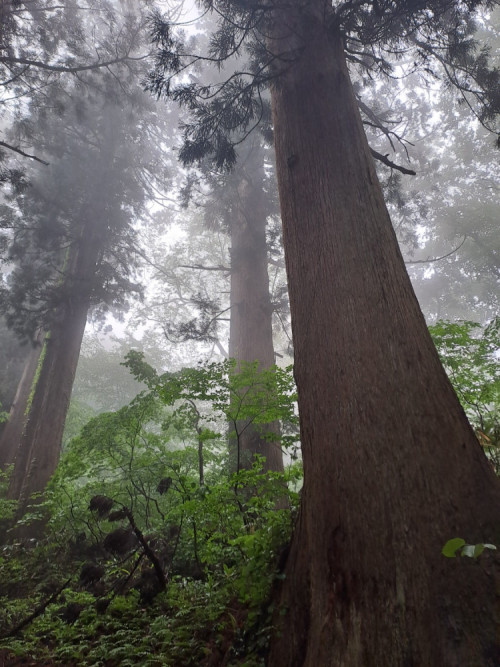
My translations, as quoted from Ven. Togawa Anshō's works in the Research Series on the History of Mountain Religion, Vol. 5 (1976) Studies on the Three Mountains of Dewa and Tōhoku Shugendō. Many in the world of Shugen and esoteric Buddhism may know of Togawa Anshō through his work as a pioneer in the field of folklore and religious studies. Less known is that he was a realised practitioner himself, having at one point in his life also served as the resident priest of the Kongōjūin. Although his work is defined by the field of folklore studies, his outlook is that of a seasoned practitioner, and thanks to him much of the history from elders and seniors of Haguro's Shugen Dharma stream, as well as remnants concerning the destruction surrounding the edict of kami-buddha separation have been recorded. The photo to the right is my own (the forest surrounding Kotakuji).
_______
1. Tōhoku and Mountain Faith
When, and in what manner, did the Buddhadharma enter the Tōhoku region? What kind of beliefs did the people of Tōhoku possess at the time of Buddhism's arrival? When Buddhism entered the region, did the people of Tōhoku have divinities of their own, as the people of Yamato did at the time of the official transmission of Buddhism? If they did, what kinds of gods did they worship, and in what manner did they worship them? With such questions in mind, I have read a variety of materials, but the matter still remains largely unclear.
Although I have long wished to clarify, by means of the methodology of folklore studies, the process by which Shugendō came into being and developed (centred particularly on the Shugendō of the Three Mountains of Dewa), as well as the faith and ritual-magical functions that it possessed, the fact that until now I have failed to examine these particular questions is due to my own lack of discernment, and is something for which I cannot but feel deeply ashamed. Yet, on reflection, problems of this kind cannot be resolved through the efforts of a single academic discipline or a single individual alone. It seems to me that they can only be clarified if the various neighbouring disciplines cooperate with one another, supplementing and filling in the points at which they intersect.Even so, if one were simply to sit with one’s hands folded and wait for that to happen, there would be no knowing when such questions might finally be resolved. If that is so, then even if the results obtained are necessarily incomplete, there is no choice but to attempt the investigation oneself. With this in mind, I decided to begin by trying to resolve this question.
2. The Tōhoku Region and Early Historical Sites
In order to answer this question, we must begin by investigating the history of the Tōhoku region. Now, at the Kamiyachi Site on the left bank of the Shirakawa River in the upper reaches of the Mogami River (located in Nakatsugawa, Iide Town/Nishi-Okitama District) excavations conducted by Yamagata University and others uncovered more than one thousand Early Paleolithic artefacts.Judging from these remains, it can be said that humans may already have been living in the region more than 35,000 years ago. In addition, Early Paleolithic remains are also said to have been excavated from such sites as the Amidado Site (Ōmori Town, Hiraka District, Akita Prefecture) and the Akiu Site (in Akiu Town/Natori District/Miyagi Prefecture). These examples represent the earliest limit presently known for human habitation in the Tōhoku region. However, no artefacts have been discovered at these sites from which we can determine what kinds of religious beliefs these people may have held.
3. Artefacts of the Jōmon People
Although various difficult questions remain, the earliest artefacts that can be regarded as religious in character do not appear until the Neolithic period. In Japan, the use of Jōmon-style pottery began with the onset of the Neolithic period, and this type of pottery is found only in Japan. Many points concerning the origins of Jōmon pottery still remain unclear. According to radiocarbon dating , its beginnings are said to go back as far as 12,000 years ago. There are, however, also theories that place its origin considerably later. In any case, since its use continued until around 200 BCE, Jōmon pottery was employed over an extraordinarily long period, ranging from several thousand years to as much as ten thousand years. In addition, among objects thought to have been religious artefacts of this period are clay figurines, clay tablets, clay masks, and stone rods.
The oldest clay figurines are found from as early as the Initial Jōmon period, but with the beginning of the Yayoi period they disappear entirely. Moreover, their precise use and function have still not been fully clarified. However, the exaggerated swelling of the breasts and hips in these figues indicates that they represent women. It is also thought that the deliberate removal or breakage of parts of the body, together with the fact that many examples were buried within stone enclosures or pits, probably had religious and magical significance.
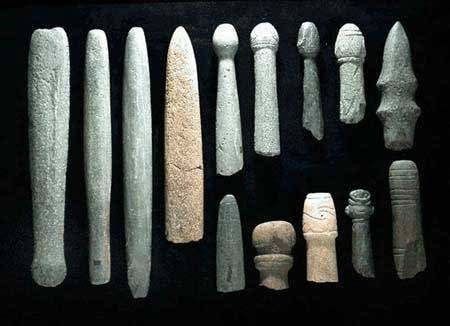
What we refer to as stone rods (sekibō) are a kind of polished stone implement excavated from Jōmon-period sites. They range in length from around 30 centimetres to more than one metre. There are double-ended types, with both ends enlarged, and single-ended types, in which only one end is enlarged. The larger examples belong to the Middle Jōmon period, while from the Late through Final Jōmon periods there is a tendency for them gradually to reduce in size. As for the use and function of these stone rods, some scholars, based on their shape, have regarded them as connected with phallic worship, while others have suggested that they represent weapons and served as symbols of authority.
From the Chūbu region through the western part of the Kantō region, there are also examples from Middle Jōmon dwelling remains in which stone rods have been excavated still standing upright.A similar example was discovered in the remains of a Middle Jōmon dwelling at Okayama (Tsuruoka City, Yamagata Prefecture). Even among archaeologists, there appears to be no unified view concerning the use and function of these stone rods. Were they symbols of authority, or were they objects of worship? If the latter, then what kind of sacred status did they possess? Questions such as these remain.
Although there are various unresolved problems of this kind, there is virtually no disagreement that these objects were connected with religious faith. Clay tablets and clay masks are generally understood in much the same way. Viewed in this light, insofar as we judge from surviving artefacts, it appears that it was during the Neolithic period that the people of Japan first came to possess material objects connected with religious belief, and that these beliefs were extremely simple in character and strongly magical in nature.
4. The Origins of Rice Agriculture and the Emergence of Political Society in the Tōhoku Region
The Jōmon period was an age in which hunting, fishing, and gathering formed the basis of subsistence. However, from archaeological remains dating from the middle of the Final Jōmon period onward in western Japan, pottery bearing impressions of rice grains has occasionally been discovered.From this, it is thought that although the social basis of life from the middle of the Final Jōmon period onward was still sustained by hunting and gathering, rice cultivation gradually began to be introduced within that way of life. However, it was only from the Yayoi period onwards that rice agriculture became dominant and society as a whole came to be sustained by rice cultivation.
In the Tōhoku region, the earliest remains connected with rice cultivation were discovered at the Minamimiyama Site (in Aizuwakamatsu City, Fukushima Prefecture), and at two other locations. At the Minamimiyama Site, pottery of the same type as the woman-form-style pottery (女方式土器), one of the oldest forms of Yayoi pottery known from northern Kantō, was excavated. These too bear impressions of rice grains. At the Suzunuma Site (in Kakuda City/Miyagi Prefecture), Yayoi pottery with cord-impression decoration and incised designs was found together with stone harvesting knives. From this, it became clear that by the period in which this pottery was being produced, rice cultivation had already begun in southern Miyagi Prefecture.
Yayoi pottery bearing erased-cord-mark decoration and incised kōji-pattern designs is often discovered mixed together with Ōbora-style pottery, the final type of Jōmon pottery. For this reason, there was once disagreement over whether the former and latter belonged to the same period or to different periods.
However, at the Sannō Site (in Ichihasama Town /Kurihara District of Miyagi Prefecture), pottery with cord-marking decoration and incised pattern designs was excavated from an upper layer separated by an intervening stratum of approximately 30 centimetres, while Ōbora-style pottery was excavated from the lower layer. This demonstrated that the two differed not only in form but also in date. Moreover, although this pottery represents the oldest such material known from the Tōhoku region, within the chronological sequence of Yayoi pottery it belongs to the Middle Yayoi period. Considering these points, it has come to be said that the beginning of rice agriculture in the Tōhoku region can, broadly speaking, be dated to around the beginning of what's termed the Common Era.
The earliest agricultural sites, like Jōmon sites, are located on low terraces or slopes, and frequently overlap with Jōmon-period sites. At that time, cultivated fields were situated on narrow patches of level ground at the heads of valleys, and were small in scale, making use of naturally flowing water and spring water. Hunting, fishing, and gathering probably still remained important means of subsistence. However, subsequent archaeological discoveries have clarified the development of agricultural techniques, and it has become apparent that by around the first and second centuries, wet-rice cultivation had spread not only to the Tsugaru Plain, but even as far as the Shimokita Peninsula. From this perspective, although it is admittedly a very rough way of putting it, it seems possible to say that, from at least the second century onward, the people of Tōhoku were rice-farming people. From this, it can be said that rice cultivation became the foundation of culture during this historical period, and that the cultures that emerged at large cannot be considered apart from rice agriculture.
One of the major characteristics of rice-cultivation culture is reverence for nature: regarding mountains, rivers, grasses and trees; the sun, moon, and stars; birds, beasts, insects, snakes; and indeed all the myriad phenomena of the universe as divine, bowing before them and offering prayers. What is called Ancient Shintō (ko-shintō), in fact, arose precisely from this dynamic.
Seen in this light, as noted above, since wet-rice cultivation had already spread by around the first and second centuries, it may be supposed that this development served as a catalyst for beliefs in reverence for nature to emerge and develop among the people of Tōhoku, and that faiths directed toward mountains had also begun to take on a fairly distinct form. What I would now like to consider is the cultural structure of the Tōhoku region from the fifth century onward. This means leaping ahead by several centuries, but by that time burial mounds (kofun) were being constructed in southern Tōhoku, and political societies had also been formed.
By contrast, the peoples of northern Tōhoku were still collectively being called Emishi and were treated as people outside the boundaries of civilisation.
5. The Establishment of Mutsu Province
"Mutsu, on northern Honshū, was one of the last provinces to be formed as land was taken from the indigenous Emishi, and became the largest as it expanded northward."
The date at which the province called Mutsu was established is not clear. However, not long after the Taika Reform, it appears under the name Michinoku Province.
The earliest instance in which it is written as Mutsu no Kuni occurs in an entry for the fifth month of Jitō 3 (689) in the Nihon Shoki (Chronicles of Japan), where we find the expression “Usugumo District of Mutsu Province”. Twenty-four years later, in Wadō 5 (712), when Dewa Province was established, this distict, together with Mogami District, was separated from Mutsu Province and incorporated into Dewa Province. Thereafter, between Yōrō 6 (722) and Jinki 1 (724), military installations (chinjō) were established throughout the provinces.
In Tenpyō 1 (729), this institutional structure was expanded and became Taga Stockade. Later, in Hōki 10 (779), it was reorganized as Taga Castle, while at the same time acquiring the functions of a provincial governmental/administrative headquarters. At Taga Castle there was also established a military headquarters, and it is thought that a temple was attached to the complex which functioned in effect as the primary temple of Mutsu Province. This can also be inferred from the fact that outlying institutions of Taga Castle, such as Tamatsukuri Stockade and the Shirakawa military corps, likewise had official temples attached to them for the purpose of praying for the administration of the northern frontier and the protection of the State.
Dewa Province was no exception to this frontier violence. Not only was a temple called Shitennōji attached to Akita Castle, but Buddhism had in fact spread into the Tōhoku region even earlier than this.
If we continue reading a little further in the entry for the third day of the first month of Jitō 3 (689) in the Nihon Shoki, cited above, we find that two Emishi -- Shiriko and Omaro, together with another Emishi named Tetsuori, requested permission to take tonsure and enter the Buddhist order, and their request was granted. Moreover, the entry for the first day of the seventh month of the same year records that Buddhist images and ritual implements were bestowed at the request of a Buddhist monk named Jitoku, who had himself arisen from among the Emishi of Mutsu Province. Seen in this light, it can be concluded that Buddhism had already penetrated quite deeply among the local inhabitants themselves. In this way, in Tenpyō 13 (741), provincial temples were established by the imperial edict of Emperor Shōmu. Unfortunately however, not a single Buddhist image that ought to have been enshrined in those temples has survived. For that reason, we do not know what kinds of principal images or attendant Buddhist images were enshrined in the individual temples, nor what artistic styles they followed. Most likely, however, they were not greatly different from the styles of Buddhist images and sculpture found in the central regions of Japan.
As if to support this, a small number of miniature gilt-bronze Buddhist images, thought to have been works produced in the central regions between the latter half of the seventh century and the eighth century, survive in places such as Aizu and Yokote. All of these are images of Shō Kannon Bosatsu (the fundamental form of the bodhisattva Avalokiteśvara). We have no choice but to use such surviving objects as clues in attempting to imagine what conditions were like at that time. On this basis, it has been supposed that Buddhism in the Tōhoku region during this period was probably associated with the Six Schools of Nara.
6. Tokuitsu: A missionary of sangaku shinkō Mountain Faith
With the beginning of the ninth century, circumstances changed considerably. This began when Tokuitsu (徳一), a scholar-monk of Tōdaiji in Nara (and at that time such a leading authority on Hossō doctrine that even Kūkai earnestly sought him out), left the capital for unknown reasons, and travelled to the eastern provinces, eventually settling in Aizu.
He opened Mount Tsukuba, which was ranked among the eminent Myōjin Taisha and was revered as a major centre of popular faith, and established Chūzenji Temple at its base. He made the temple a training ground for Buddhist practice while at the same time spreading beliefs based on the harmony of kami and buddhas (神仏習合; shinbutsu shūgō), thereby exerting a major influence among the people. His activities also extended into the Tōhoku region. After eventually moving to Aizu, he established Enichiji at the foot of Mount Bandai and made it the adminstrative temple of Bandai Shrine. At the same time, he invoked and enshrined the divinity Bandai Myōjin within the temple precincts, making the deity both the temple’s tutelary deity and its village shrine.The mountain itself was then revered as both the principal shrine and its inner-precinct.
In this way, Tokuitsu transformed mountain faith, in which the mountain itself was revered as a deity, into a system in which buddhas and kami stood side by side, and developed it into a belief in the fundamental identity between kami and buddhas, what is termed 'the single essence of kami and buddhas (shinbutsu-dōtai) or the non-separation between kami and buddhas (busshin funi).
In this sense, together with Shōdō Shōnin, who opened Mount Futara in Shimotsuke, and Mangan Shōnin, who founded Mount Hakone in Sagami, Tokuitsu was one of the pioneers who brought together mountain faith and Buddhism in the eastern provinces. It is also said that he was a son of Emi no Oshikatsu, but the first account of his life appears only in the Genkō Shakusho, written in the Kamakura period more than five hundred years after his death. For this reason, relatively little detailed information about him has been transmitted. Of his writings, only one fascicle of the Shingonshū Miketsubun (真言宗未決分), which criticised Kūkai’s doctrinal system, survives. Apart from this, there remain only passages from his works quoted in the writings of Saichō, who engaged in fierce doctrinal controversy with him, for the purpose of criticising Tokuitsu. It does, however, appear certain that Tokuitsu ultimately passed away at Enichiji. Tokuitsu is said to have lamented that the monks of his time were preoccupied solely with their own advancement and worldly success and had fallen into comfort and luxury. He himself is said to have lived an unusually simple daily life of coarse food and worn clothing, while strictly maintaining the precepts. A letter addressed to him by Kūkai, in which Kūkai speaks his praises likewise states:
“..Practising austerities, [Tokuitsu] left the capital, shook his mendicant staff, and journeyed eastward..”
Thus, Tokuitsu’s journey from the Kantō region into Tōhoku was a single-minded journey dedicated to seeking the Way and fulfilling the Dharma, undertaken without regard for fame or reputation. He brought Buddhism into major regional sacred centres of popular belief, such as Mount Tsukuba and Mount Bandai, and taught the doctrines of unity and identity of kami and buddhas. In doing so, he attributed buddha-nature to the kami, while at the same time newly associating divine status with buddhas. In this way he constructed a theoretical basis for shinbutsu shūgō and exerted a profound influence upon the popular beliefs of the people.
At Enichiji, however, not a single Buddhist image or ritual implement from Tokuitsu’s own time has survived. All that has been passed down is a single three-pronged vajra made of white bronze, with sharply pointed prongs, thought to date from the eighth century. Implements such as the three-pronged vajra, single-pronged vajra, and five-pronged vajra are ritual implements of esoteric Buddhism. They are not implements that one would normally expect a monk of the Hossō school, such as Tokuitsu, to use. However, even before Saichō and Kūkai introduced systematic forms of esoteric Buddhism, partial forms of esoteric practice had already reached Japan - including forms referred to as old esoteric Buddhism (ko-mikkyō) or Miscellaneous esoteric Buddhism (zōmitsu). Among officially recognised monks, there were also many who studied such teachings, entered the mountains in accordance with them, and acquired Dharmic and thaumaturgic efficacy (jugenriki). With this in mind, it is entirely possible that Tokuitsu himself possessed this kind of training and knowledge. By entering mountains such as Mount Tsukuba and Mount Bandai, which local people revered as powerful deities, and by attempting to harmonise popular faith with Buddhism, he succeeded both in establishing contact with the people and in drawing them toward the Buddhadharma.
The images of the Yakushi Triad preserved at Shōjōji in Aizu, which display a strong Tenpyō-period style, are also thought to have been created under the influence of Tokuitsu. Although it dates from a later period, a document known as the “Old Plan of the Enichiji Temple Precincts” shows more than twenty temple halls and pagodas arranged in a manner reminiscent of a mandala. Among them can be seen titles such as the Konpondō, Chūdō, a three-storey pagoda, Amidadō, and Kannondō. Intermingled with these are also depictions of a Jūōdō (a hall dedicated to the ten kings of the underworld) and a torii gate. If this arrangement of the temple complex was based on Tokuitsu’s own conception, then although he took Hossō (Yogācāra/Consciousness-Only) as his doctrinal foundation, upheld the doctrines of the five distinct natures (五性格別), the reality of the Three Vehicles (三乗真実), and the skillful means of the Ekayana (一乗方便), and criticised Saichō’s Lotus Ekayana doctrine (法華一乗主義), according to which all sentient beings without exception possess Buddha-nature, while also attacking Kūkai’s esoteric, supra-logical mode of thought, he nevertheless appears to have embraced a faith in the unity of kami and buddhas. This faith was likely grounded in the unified worldview of the Lotus-Treasury World, embodied in the Vairocana Tathagata of Tōdaiji. The fact that sacred mountains and sacred places throughout the Tōhoku region, including mountains believed to be the dwelling places of local land deities, came at an early stage to assume forms informed by shinbutsu shūgō, and that Shugendō practitioners came to serve them, was probably influenced by activities of this kind on the part of Tokuitsu and his followers.
While writing this study, as I travelled among temples and mountains throughout the Tōhoku region, visited ancient remains and archaeological sites, and paid reverence before their main deities (principal images), this thought never left my mind.
7. Awe and Fear toward the Mountains and Refuge in the Buddhas
In Jōwa 4 (837), a report from Mutsu Province reached the Imperial Court. On the sixteenth day of the fourth month, the hot-spring stone deity under the jurisdiction of the Tamatsukuri Fortification (Nakaniida Village, Kami District, Miyagi Prefecture) began to shake with a tremendous roaring sound and continued without stopping, day and night. From the hot spring, hot water resembling cloudy rice-water gushed forth and flowed like a river; the mountain burned, valleys were blocked, rocks collapsed, trees snapped, and a massive new marsh was formed. Moreover, the sound of the boiling water was like thunder, and many other strange phenomena were also said to be occurring in unison.
The government, upon receiving the report, did not regard this as merely a natural disaster or terrestrial upheaval, but interpreted it as a omen of rebellion by the so-called barbarian enemy, and ordered the provincial governor to instruct and pacify them so as to prevent a rebellion before it occurred. Two years later, on the seventeenth day of the tenth month of Jōwa 6 (839), another report stated that, on the western coast of Dewa Province, following more than ten days of prolonged rain accompanied by violent thunderstorms, enormous numbers of meteorites resembling stone arrowheads and spearheads were found lined up pointing northward. In this case as well, the phenomenon was interpreted as an omen of an unforeseen calamity, and orders were given to present offerings to the shinbutsu and to perform prayers.
In order to divine such omens of natural disaster or rebellion as early as possible, an edict of the Council of State issued in Ninju 1 (851) reduced the authorised number of officials by one and established one position for a Yin-Yang diviner (onmyōji). Then, in Jōgan 15 (873), following the precedent of Musashi Province, the Five Great Vidyāraja were installed in the provincial temple in an effort to crush the enemy ambitions and placate the fears of officials and commoners. The Five Great Vidyaraja are also called the Five Great Honoured Ones or the Five Great Wrathful Honoured Ones. They are the command-wheel bodies of the Five Great Bodhisattvas (godairikibosatsu), who are said to protect rulers who take refuge and accord with the three jewels. A command-wheel body is the wrathful form provisionally manifested by buddhas or bodhisattvas in order to guide violent beings who cannot be converted by ordinary means. They are also regarded as the command-wheel bodies of the Five Buddhas, or Five Wisdom Tathāgatas of the Vajradhatu. With Fudō Myōō at the centre, they consist of Gōzanze Yasha Myōō, Gundari Yasha Myōō, Daiitoku Yasha Myōō, and Kongō Yasha Myōō. Because these vidyāraja were believed to possess the power to pacify and secure the realm and subjugate demonic obstacles, they were especially deeply revered in the Tōhoku region. However, among extant ninth-century Buddhist images in the Tōhoku region, images of Yakushi Nyorai and Kannon Bosatsuare numerous, while representations of the Five Great Vidyāraja do not appear until after the tenth century. Images of Bishamonten, revered as a martial deity, are also surprisingly few.
Yakushi Rurikō Nyōrai (medicine buddha), is the lord of the Eastern World and is also called the Great Medicine-King Tathāgata. Since the Asuka period, this buddha has been worshipped and represented in images as one who removes the illnesses and afflictions of sentient beings, brings their faculties to completeness, and guides them to liberation. He has little official function, however, in "repelling hostile enemies", and does not appear in the Mandalas of the Two Realms. Nevertheless, he is of the same body as Akṣobhya of the Vajradhatu and Mahāvairocana of the Garbhakosha, and his command-wheel body is Gōzanze Yasha Myōō (and also Fudō Myōō). From this perspective, therefore, the majestic power of this buddha is no less than that of the various wrathful deities. Kannon Bosatsu, on the other hand, is an all-powerful bodhisattva who, in response to the appeals of sentient beings, immediately extends a hand of compassion and salvation at any time and under any circumstances. With Myōken Daibosatsu (the deification of the Big Dipper), and Gundari Yasha Myōō (among other things, the deification of the Southern Cross) as attendant deities, and with the Twenty-Eight Attendant Deities, the deifications of the Twenty-Eight Lunar Mansions, as retinue, Kannon destroys all hardships, disasters, and hostile enemies and causes beings to dwell in a state of peace and security. For officials and armed settlers who feared natural disasters and terrestrial upheavals as signs of rebellion by hostile peoples, Kannon must therefore have been seen as a divinity upon whom they felt they could rely.
Tokuitsu, however, was a scholar of the Hossō school who maintained a certain distance from esoteric Buddhism, and so he presumably did not hold ideas developed to this extent. In any case, it is regrettable that the only one of his writings surviving in complete form is Unresolved Questions Concerning the Shingon School, while the remainder of his thought can only be inferred from the writings of Saichō, his opponent in doctrinal controversy.
8. The Kami and Buddhas of the Tōhoku Region
Let us now turn our attention to matters concerning the kami (jingi). For the reasons touched upon earlier, many of the gods were nature deities. As culture developed, however, the gods also came to combine various characteristics: some became anthropomorphic or personal deities, while hierarchical rankings among them also emerged. Moreover, with sections that understood the emperor to be a manifest human deity, their came ideas that he could confer ranks and grades of merit upon the gods and could even issue commands to them.
According to the ancient system governing the kami, shrines participating in state ritual were called official shrines, and these were divided into major and minor shrines. Some received offerings from the Department of Divinities, known as court offerings, while others received offerings from the provincial governor, known as provincial offerings. These deities were registered in the Register of Deities.
The Register of Deities was established in the Kōnin-shiki records, passed through the Jōgan-shiki records, and took final form in the Engi-shiki records. Since the Kōnin-shiki and Jōgan-shiki have not survived and only the Engi-shiki remains extant, shrines recorded in the latter have conventionally come to be known as Engi-shiki-listed shrines. Looking, therefore, at the Engi-shiki, all of the Engi-shiki-listed shrines of the two provinces of Ōu were provincial-offering shrines, and there were no court-offering shrines. Mutsu Province had one hundred shrines representing one hundred divine seats, while Dewa Province had nine shrines representing nine divine seats. Among these, fifteen shrines in Mutsu Province and two in Dewa Province belonged to the category of eminent deities receiving the Eminent-Deity Rite.
If we attempt a rough classification of these 109 Engi-shiki-listed shrines (式内社), thirty-two were connected with mountains, twenty-one with water, fourteen were stone deities, five enshrined local deities, eight belonged to the tradition of Kashima Myōjin (a martial deity), and two to the tradition of Katori Myōjin. A further twenty-seven were connected with deities of central origin, such as Ōkunitama-no-kami (大国魂神) and Taga Shrine (多賀神社), which are thought to have been worshipped by provincial rulers stationed in this region before the establishment of Mutsu Province.
In addition, although they were not included among the Engi-shiki-listed shrines, more than ten other shrines contained deities that had been granted court ranks and grades of merit. Almost all of these gods were nature deities, that is, mountain gods, river gods, marsh gods, stone gods, and the like. Deities possessing a martial character or the character of gods originating in the central polity were surprisingly few, just as was the case among the Engi-shiki-listed shrines discussed above.
The deity of Mount Bandai is called Iwahashi-no-kami, which indicates that it too was a nature deity in which Mount Bandai itself was revered as a divinity. Tokuitsu opened this mountain as a site of practice, converted the deity, established Enichi-ji at the foot of the mountain, and enshrined a Buddha there. By teaching that this Buddha and Iwahashi-no-kami were of the same body, he appears to have promoted a form of belief that later became the matrix for shinbutsu-shugo and the theory of original ground (本地; honji) and manifested traces (垂跡; suijaku).
The Buddhist images that Tokuitsu established at Enichi-ji do not survive today, so it is impossible to know what they represented. However, judging from the Buddhist images and temples in the area surrounding Aizu, it appears possible that, after Tokuitsu's death, his successors identified the original-ground of Iwahashi-no-kami with Yakushi Rurikō Nyorai.
Among monks who might be regarded as predecessors of Tokuitsu were men who entered such mountains as Mount Katsuragi, Mount Ōmine, and Kinpusen, undertook severe ascetic cultivation and practice, learned and recited incantations, formed mudras, practiced visualisations, cured illnesses, prayed for rain, and pacified vengeful spirits, thereby demonstrating Dharmic and miraculous efficacy. Some were consequently summoned to the Inner Ritual Hall of the Imperial Palace. Nor were there few outstanding esoteric Buddhist monks of the Tendai and Shingon schools who, from shortly after Tokuitsu's death onward, sought to propagate Buddhism and undertake itinerant preaching in the Tōhoku region. The number of monks taking up appointments at provincial temples also increased with each passing year.
As a result, the ideas of kami-buddha harmony (shinbutsu shūgō) and original ground and manifested traces (honji suijaku) whose seeds had been sown by Tokuitsu developed rapidly under the stimulus of general Buddhist theories of the Buddha-body, Tendai doctrines of fundamental wakefulness (hongaku) and wakefulness acquired through practice, theories centered on non-duality or non--distinction ("neither two nor one") and the esoteric theory of the Three Wheel-Bodies. It appears that the temples of Mutsu and Dewa gradually became increasingly connected with mountain faith.
Even among the Buddhist statues and temple ruins that survive today, many are found in the mountains or at the foot of mountains. Even officially designated temples, which enjoyed a status comparable to government temples, were established in such locations. This appears to indicate that worship of mountains shifted from a Shinto-oriented form toward a Buddhist form. If so, many of the monks who mediated this transition were probably, like Tokuitsu, privately ordained monks of Tendai or Shingon affiliation who had experience of mountain ascetic practice and took the form of ascetics and yamabushi. Although they might say that Tendai was their school or that they followed Shingon, they did not possess a head temple upon which they depended, nor did they have a temple that could serve as their registered place of origin. Even though they undertook self-vowed ordination and wore black robes, this may have meant little more than that they cut their hair and did not tie it into a topknot; probably relatively few assumed the appearance of a completely shaven, round-headed monk. I do not know when the expression “hairy monk” first came into use, but they were precisely the sort of people for whom such a term would have been appropriate.
9. Ritual Specialists, Shugendō Practitioners, and the Mountain
Shugen practitioners, who might be described as a hybrid between privately ordained monks and the village shrine functionaries known as negi (禰宜) and hafuri (祝), tied their hair into a hanging, braid-like form called tekihatsu (摘髪). This may have been a sign that they belonged to the lineage of privately ordained monks.
The “hairy monks” and Shugen practitioners had wives and raised children. They built small hermitages on vacant land at the edge of villages or beside shrines, where they performed kito, and other ritual services at the request of villagers. They also performed purification rites, proxy ablutions, and were involved in funerary rites and the disposing of corpses that had been abandoned along roadsides.
Villages had a considerable number of days on which the gods had to be worshipped, for example, at the beginning of the year, at seed-sowing time, during flower festivals, and during river festivals. In villages where there was no negi or hafuri to take responsibility for worship of the gods, these practitioners may have acted in their place. The practice of Shugendō practitioners reciting Shinto liturgical prayers and cutting ritual offerings appears to have been connected with such circumstances.
Even among fairly well-educated people, many do not know the distinction between primitive Shinto and Shrine Shinto. Consequently, many assume that shrines which, until their shrine ranks were abolished under the so-called Shinto Directive issued by the Occupation authorities after the end of the war, had possessed high ranks such as Court-Offering Shrine or Provincial-Offering Shrine, as well as ordinary village tutelary shrines and clan-deity shrines, had always existed in the same form as they did after the Meiji period and had always been worshipped in the manner seen up to the Second World War. Yet when one considers the matter, this was simply common knowledge among people who had received a prewar education.
Although many people know that the edict of separation of kami and buddhas (shinbutsu bunri) was carried out at the beginning of the Meiji period by government order, in the form of proclamations of the Council of State, they often believe that it applied only to unusual places such as Iwashimizu, Nikkō, Kotohira, and Mount Haguro. Many believe that shrines connected with the Imperial family, such as Ise Jingū and Atsuta Jingū, as well as village tutelary shrines, had never exhibited shinbutsu-shugo.
Many of the chief priests of village clan-deity shrines and tutelary shrines in the Tōhoku region belong to hereditary families. More than a century has now passed since the separation orders (shinbutsu-bunri), and the current heads of these families are often the third or fourth generation since that time. Moreover, what was removed during the separation was not limited to Buddhist statues, ritual implements, and scriptures. In some cases, old records were also burned or torn up, and even within the family it became taboo to speak about the period when their ancestors had served as Shugendō practitioners.
For this reason, many younger Shinto priests know almost nothing of the fact that the shrine at which they serve was once called a gongen and that Kannon had once been worshipped there. The parishioners, however, often continue, in accordance with old custom, to call the chief priest a hōin (法印) or yanbushi. Yanbushi is a dialectal form of the word yamabushi, while hōin derives from the fact that the highest title of a yamabushi - what was called an ecclesiastical rank - was Gondaisozu and Hōin.
Ordinarily, in order to be permitted such a title, one had to complete several rounds of mountain-entry ascetic practice or render exceptional service to the head temple (honzan). Through the practice known as seikō, however, it was possible to receive permission after only a single mountain-entry practice, provided that one paid a fixed sum to the head temple, known as "rank-money". During the Edo period, it was customary to cover the expenses required for mountain-entry practice by circulating a donation subscription register among believers and receiving contributions. Consequently, rather than having the yamabushi make two or three separate journeys and being asked to contribute money and grain on each occasion, it imposed less of a burden if he could obtain promotion after only one journey.
Furthermore, at gatherings of yamabushi or at major local festivals, to see the yamabushi of one's own village wearing ritual robes and a Buddhist stole that indicated a low rank and sitting at the very lowest place was felt to reflect upon the honour of the villagers themselves. For these reasons, the believers made their contributions half reluctantly and half willingly. This feeling is exactly the same as that of temple parishioners today who donate money because they want the abbot or resident priest of their family temple to wear particular kinds of brocade vestments. In any event, the fact that village chief priests are still called hōin or yanbushi indicates that, until three or four generations ago, their families consisted of yamabushi Shugendō practitioners who had charge of the village clan deity and served it.
Even if they themselves have forgotten this, provided that they have a desire to investigate, it should be possible to discover such matters to some extent by consulting temple death registers, village documents, and the local topographical and historical works that were compiled so actively in various regions from the closing years of the Tokugawa shogunate through the middle of the Meiji period. A family may say, “Our house has served this shrine from ancient times under the title of such-and-such tayū. So many generations ago, our ancestor travelled to Kyoto and received from the Yoshida family a licence to wear an eboshi court cap and hitatare formal robes, and was granted a provincial-governor title.”
A shrine may likewise claim, “Our shrine enshrines the three deities Emperor Ōjin, Empress Jingū, and Takenouchi no Sukune, and has never had a Buddha as its principal object of worship.”
Yet when one looks inside the main sanctuary of such a shrine, there may be a miniature sanctuary or Buddhist image cabinet indicating that a Buddhist image was once installed there. From the storage compartment beneath the ritual altar may emerge an image of Amida Nyorai--the original-ground Buddha of Emperor Ōjin, identified with Hachiman -along with Buddhist ritual implements, scripture scrolls, and similar objects. Or there may be a wooden box suspended from a beam in the attic of the residence, which rumours say may cause one to go blind if opened.
There are also quite a few cases in which a family claims: “Our household has served this shrine since ancient times under the title of such-and-such tayiū, and several generations ago one of our ancestors went up to Kyoto, received from the Yoshida school authorisation to wear an eboshi court cap and hitatare formal robes, and was permitted to use a provincial-governor title”; or in which a shrine claims: “Our shrine enshrines the three deities - Emperor Ōjin, Empress Jingū, and Takenouchi no Sukune as its enshrined deities” - yet among the documents of a person who had been authorized to wear hitatare, there were also found several certificates of appointment stating that they were appointed various kinds of Shugen rankings. Cases of this kind are by no means rare.
From the middle of the Edo period onward, the Yoshida school appears to have dispatched envoys throughout the country to conduct inspections of Shinto priests and inspections of mikō-mediums, thereby bringing them under its authority. Some materials describing these inspection circuits can also be found among domain records and village documents. The ritual purification known as the shime-oroshi of pilgrims undertaking the “Pilgrimage to the Seven Shrines” - that is, pilgrimages to the seven sacred sites of Ise, Kumano, Fuji, Hakusan, Atago, Mishima, and Nikkō - is said from ancient times to have been under the administration of the Honzan-ha sect of Shugen. Many documents survive showing that Shugen practitioners were active within areas that properly belonged to Shinto priests. At major temples in the Tōhoku region, at shrines bearing the title gongen, and even at shrines that did not use the title gongen but where Buddhist monks served as bettō (shrime-temple administrators), one often finds, beneath the bettō, several monks and Shugen practitioners, together with lower-ranking ascetic yamabushi known as rokku or jōji, as well as Shinto priests holding titles such as taiyū or kokushi.
As far as I have been able to ascertain, this practice dates from the Tenbun era (1532–1555) onward, and it was also from around this period that the officials of Mount Haguro began issuing kasumijō (territorial authorisation documents) to persons holding a kokushi title. It cannot be denied that mountain faith, which originated in nature worship, was systematised by Buddhists and developed into the form of mountain faith known as Shugendō. At the same time, however, it likewise cannot be denied that this was preceded by ancient or primitive Shinto, and by ritual observances conducted by hafuri and negi. It becomes immediately apparent when the texts are compared that Shinto norito were influenced by such elements as ritual regulations and liturgical recitation texts found within Buddhist orders of service and kōshiki. Likewise, rites such as the Purification of the Six Sense Roots used by Sect Shinto and miko spirit-mediums express Shinto concepts of purity, brightness, and uprightness by borrowing Buddhist terminology. Nor was this influence limited to ritual language. Even Shinto shrine architecture developed under the influence of Buddhist temple architecture, while at the same time establishing itself through a rejection of the latter’s ornate splendour.
The kami descend into the human realm from time to time, on particular occasions, but as soon as the matter is concluded they immediately return. The place at which they descend was always fixed. If it was a tree, it was called a sacred enclosure for the deity; if it was a rock, it was called a sacred stone boundary; and a place where a temporary structure was erected to receive the deity was called a yashiro. This is why, even after permanent shrine buildings came to be constructed, they continued to be called yashiro. Yet even after shrines had been established, the idea remained unchanged that the kami did not permanently dwell there and did not reveal their forms to human beings. For this reason, at the beginning and end of festivals, rites for the descent of the deity and ascent of the deity were performed, and images of the kami were not made, except in the case of deities that had developed a special relationship with Buddhism.
I myself was born the son of a Shugen monk, was raised in a temple from around the age of five or six, studied at a middle school and university belonging to the Buddhist denomination, and began Buddhist-yamabushi training when I was ten years old. Because of this, I felt a deep familiarity with mountains and held the belief that mountain deities were beings that brought happiness to human beings. Nevertheless, on occasions when I had to set out in the middle of the night from the village temple at the foot of Mount Haguro towards the main temple quarters in the mountains, I would often feel afraid that some uncanny being might attack me, startled by such things as the rustling of leaves or the cries of mountain birds suddenly taking flight in surprise at the light of my lantern. At such times, I would admonish myself that I felt this way only because I was cowardly, or that I was seeing hallucinatory phenomena because the flame of the lantern was flickering, and I would carry the lantern over my shoulder. By doing so, the lantern light did not shine directly into my eyes, and consequently the path in front of me actually appeared brighter and was easier to walk along, while no hallucinations occurred.
When I think about it, it seems to me that precisely such feelings of fear and such imaginings were closer to the emotions ancient people felt toward mountains, while reverential ideas (such as that ancestral spirits dwell there, or that the mountains distribute irrigation water), may rather have been products of later ages. Those who entered the mountains seeking to acquire Dharma power of miraculous efficacy presumably did so because they believed that practising in mountains inhabited by ambiguously natured beings was precisely the way to acquire the power needed to overcome them. The protective spirit whom such practitioners revered was Kongō Zaō Gongen. This is a wrathful deity said to have been spiritually apprehended by En no Gyōja. However, in the time of En no Gyōja the concept of gongen had not yet been established, and the actual production of images of the deity also appears to date only as far back as the Heian period. Be that as it may, the deity whom Shugendō practitioners revered even more highly than Zaō Gongen was Fudō Myōō. This was because, whereas Zaō Gongen had no scriptural or ritual text upon which to rely and no images from the Heian period appear to survive, Fudō Myōō possessed scriptural foundations, as well as old iconographic representations and sculptures. He was also known both as the command-wheel body of Dainichi Nyorai and as the central figure among the Five Great Wrathful Ones. As this tendency developed, Shugen practitioners, through the ritual technologies of esoteric Buddhism, came to regard themselves as manifestations of Fudō Myōō, and their ritual clothing and appearance also came to be modelled upon Fudō.
Despite the narrative of Haguro's Founder being linked to Emperor Sushun, his appearance is described consistently as exceedingly fearsome: his bodily colour was blue-black; his face measured one shaku nine sun; the height of his nose was more than three sun; the outer corners of his eyes extended upward to the crown of his head and disappeared into his hair; his mouth was so wide that it reached the sides of his ears; his ears were more than one shaku in length;and his voice was harsh and terrifying, so that anyone who heard it became startled and alarmed. However one considers it, this is the face of a monster. It was precisely because he possessed such an appearance that he was thought capable of subjugating of demons and violent forces, expressing the oft-encountered strange and eerie phenomena of the mountains. It seems to me that this may be the reason that Mount Haguro eventually came to be called the general tutelary sanctuary of Mutsu, Dewa, Sado, and Shin'etsu, and the domain of the thirty-three eastern provinces. The fact that Shugendō spread throughout the Tōhoku region, and that even today the severity of its training and the intensity of its ascetic practices remain unparalleled elsewhere, may be because it arose from a specifically Tōhoku tradition in which the uncanny phenomena of the mountains were linked with, and feared together with, rebellions by hostile peoples.
10. The Current State and Future Tasks of Shugendō Research in the Tōhoku Region
There are no exceptionally high mountains in the Tōhoku region. Of those exceeding 2,000 metres, there are only Mount Chōkai, straddling Yamagata and Akita Prefectures, at 2,230 metres; Mount Iide, spanning Yamagata, Fukushima, and Niigata Prefectures, at 2,105 metres; Mount Iwate in Iwate Prefecture, at 2,041 metres; and Mount Azuma in Fukushima Prefecture, at 2,024 metres.
Nevertheless, roughly ninety percent of the total area is covered by steep cliffs and ridges overlapping and folding upon one another in layer after layer. More than fifty mountains have histories in which they were once revered as sacred sites of mountain Buddhism and flourished as training grounds for Shugen mountain-entry practices.
At Tendai temple-complexes such as Chūson-ji at Hiraizumi and Risshaku-ji at Yamadera, and at Shingon temples such as Enichi-ji in Aizu, Shugen practitioners resided within the temple precincts on the mountain and came to fulfil the role of drawing the populace toward mountains, mountain temples, and mountain shrines. There can be no doubt that such mountains had already received the reverence of local people and had been served by village ritual specialists known as hafuri even before mountain-ascetic monks such as Tokuitsu, Shugen practitioners, and esoteric Buddhist monks entered them. However, today there is little surviving material sufficient to tell us how such rites were actually carried out, and the reality is that even conditions after Shugendō practitioners and esoteric Buddhist monks entered and took up residence in these mountains cannot yet be said to have been adequately investigated and studied.
With regard to Shugendō on Mount Haguro, much has been clarified through the work of Ven. Shimazu Dendō, Kishimoto Hideo, Carmen Blacker of Britain, H. O. Rotermund of West Germany, now residing in France, H. Byron Earhart of the United States, Miyake Hitoshi, and Murayama Shūichi. Regarding the ascetics of Mount Yudono, much has been clarified by Hori Ichirō. I myself have also written several books. Wakamori Tarō and Gorai Shigeru have likewise published studies on the Three Mountains of Dewa. On Mount Iwaki in Tsugaru, there is research by Wakamori; and on the itako of Mount Osore, the gomitsu of Akakurasawa, and Shugendō on the Shimokita Peninsula, there are excellent and substantial studies by Kusunoki Masahiro. Research on Nonodake has been pursued by Gekkō Yoshihiro, while Ōtomo Gisuke has investigated Hayama and Mount Kamuro. Iwasaki Toshio began his research at an early stage and has published a major work, while Suzuki Akihide was likewise among those who began studying these subjects early.
Lookintg to Mount Zaō, there is research by Takeda Kōkichi; looking to Mount Iwate and Mount Hayachine, there are reports by Moriguchi Yūne; on Mount Adatara we can look to the work of ven. Mitsui Toyooki (a Honzan-ha practitioner who also practiced with the Haguro-ha - see my translation of his major work and the notes on the shugendo teiyo); On village yamabushi within the former Akita domain, we can look to the works of Satō Hisaji; and looking to Shugenja in the southern part of Iwate Prefecture, there are numerous works by Konno Hiroo and Asano Akira. The Tōhoku Shugendō Research Association is also a newly formed development, and Asano is one of its key members. Research on the Three Mountains of Oga in Akita remains almost entirely absent, but precisely because this is an area deeply connected with folk belief, it is something that should be investigated as soon as possible. On Mount Chōkai, there is excellent research by Abe Masami, as well as articles by Matsumoto Ryōichi. Matsumoto comes from a Shugen family situated at the Warabioka entrance of Mount Chōkai, and possesses a considerable number of documents preserved by his family lineage, so further publications from him are to be expected.Kishimoto also undertook extensive research on Chōkai Shugen, but died before publishing the results. Nor can we forget Watanabe Tomeji, who pioneered research on Mount Yudono. Maruyama Shigeru devoted great energy to research on the Iwanesawa entrance, and died leaving behind his work, Reminiscences of the Sacred Capital Iwanesawa. As research on Shugendō has grown, there have also been many people who have taken an interest in such matters as the historical development and trends of Shugendō in the Tōhoku region, and the relationship between Shugendō and folk belief. However, research into Shugendō or the history of Shugendō is not something that can be successfully pursued merely because one can read old documents to some extent or happens to have an interest in local history. Still less can it be accomplished by approaching the subject with the antiquarian or dilettantish attitude into which local historians of earlier times sometimes fell.
Knowledge is required not only of specific doctrine and ritual, but also of the various schools of Buddhism, Shinto, and folk belief. In particular, among Shugenja of the Edo period, some simultaneously held the status of Tendai monks, while others simultaneously held the status of Shingon monks. These arrangements were referred to as "combined affiliation", and there were also many temples that held such dual affiliations. Following the Meiji Restoration, the Tendai and Shingon schools inherited this system. They referred to Shugendō practitioners as instructors (kyōshi), while also granting them titles such as sōgi or sendatsu. They permitted them to establish congretations and prayer halls, and to take charge of their administration, but did not appoint them as resident priests of temples. Moreover, even among fully ordained monks, some were authorized to train Shugen practitioners while others were not. Nor did being a monk authorised to train Shugen practitioners necessarily mean that one possessed what was called a Shugen rank as a Shugendō practitioner. For these reasons, it is absolutely necessary to possess knowledge of the specifities of denominational regulations and institutional rules, yet when I advise local researchers of this, there often seems to be considerable difficulty in getting this point across..
In order to grasp the overall history of Shugendō , one must also be able to distinguish between the Honzan-ha, Tōzan-ha, Hikosan-ha, Haguro-ha, and the various other lineages, but this too becomes a complicated matter -- full of misunderstandings. Some people assume that every Shugen practitioner must have belonged to the Honzan, Tōzan, Hikosan, or Haguro-ha. Others think that, because Haguro-ha was designated "Tendai Shugen" that it must have been a branch of the Honzan-ha. Although Honzan Shugen was Tendai in affiliation, it belonged to the Shōgo-in line of Mii-dera/Onjō-ji, and was neither subordinate to Enryaku-ji on Mount Hiei nor to Tōeizan Kan'ei-ji (the principal Tendai temple in the Kantō region). From Kan'ei 18 (1641) onward, the Haguro-ha lineage was recognised formally as a distinct lineage whose head temple was Jakko-ji, also called Hōzen-in (宝前院), itself a subordinate temple of Tōeizan. It was therefore clearly a separate school from the Honzan-ha. There are also people who suppose that Nikkō Shugen and Hayama Shugen, though not officially recognised as independent schools, must nevertheless have received appointments from Shōgo-in because they belonged to the Tendai order. Others, conversely, argue that there existed an independent “Hayama-ha” lineage, and that once one had received an appointment from Daien-in (the bettō of Hayama), one could operate openly and legitimately throughout the country -- but this was not the case. In actuality, Daien-in was incorporated during the Edo period as a branch temple of Tōeizan. Nevertheless, according to precedent (the precise date is unclear), but by the late Muromachi period it had been recognised as a regional centre of Shugendō and as a provincial mountain, that is, a site for Shugen mountain-entry practice, and it was permitted to exercise authority over its disciple yamabushi. However, Shugenja under Daien-in's authority could not wear the yuikesa unless, through Daien-in as intermediary, they received formal authorisation via Haguro. Hayama Shugen was therefore, in reality, under the yukessa-line authority of Mount Haguro. This arrangement was imposed by order of Tōeizan. For a Shugenja, receiving permission to wear the kesa meant, in effect, becoming subject to the authority of the institution granting that permission. This is why the head-temple/branch-temple relationship was called the “kesa lineage” (袈裟筋), the party occupying the controlling position was called the “head of the kesa” (袈頭 - kesagashira, a rank that still holds some meaning today), and the yamabushi under its control were called those “under the kesa” (袈裟下). Accordingly, the registers of branch-affiliated practitioners of the Haguro-ha include the names of a number of Shugenja who are recorded as belonging to the “Hayama-ha" in the Shinjō Domain Village Register. For example, Sanzō-in, the bettō of “Hayama and Matsuba Yakushi Nyorai” in the supplementary discussion to Ōtomo Gisuke's “A Study of Belief in Hayama in Dewa Province” is also recorded in Mount Haguro's branch-line register, while in the Shinjō Domain Village Register he is classified as belonging to the Hayama-ha. Itoku-in of Iwashimizu is recorded in the same manner. This is because, while these practitioners regarded Daien-in as their principal temple, they were at the same time under the kesa authority of the Haguro-ha.
Those who are not registered in Mount Haguro’s register of affiliated branch-templess, but who are recorded as belonging to the Hayama-ha in the Shinjō Domain Village Register, presumably did not wear the yuikesa (the formal kesa of a Shugen practitioner), but instead wore a Fudō kesa or shime-kesa, together with the cloth crown-style tokin. Even today, it appears that many of those who identify themselves with Zaō Shugen wear this kind of attire. Like Tōeizan, Mount Nikkō was an imperial monzeki temple whose head was the imperial prince-priest known as the Rinnōji-no-miya. The Shugen practitioners of Mount Nikkō were therefore under the direct jurisdiction of the Rinnōji-no-miya, and all certificates of appointment were issued by the Rinnōji monzeki. Kinpusenji in Yoshino was likewise a temple administered by the Rinnōji-no-miya, and the various appointments concerning its Shugen practitioners were issued by Kinpusen-ji itself; they were not matters over which the Honzan school exercised any authority.
Moreover, they did not call themselves the “Nikkō-ha” or the “Yoshino-ha”. The reason I earlier used the expression “various lineages” is that, although such groups did not use formal lineage-tradition names, they nevertheless existed as distinct and independent congregations. I believe that, as research on Shugendō progresses further, more examples of this kind will emerge. Partly for reasons such as these, there are still many inadequately understood aspects of Shugendō research. At present, we are, as it were, feeling our way forward with the aid of scant source materials, walking through a dark cave. The reason I traced the activities of Tokuitsu in such seemingly excessive detail in this essay was that I wished to investigate, from a direction that had previously received relatively little attention, the emergence of ideas of shinbutsu-shugō, the connection between sangaku-shinkō and Buddhism, and the historical background to the formation of Shugendō.
As mentioned earlier, among Shugen practitioners in the Tōhoku region, Fudō Myōō is treated more as the principal-image than Zaō Gongen, who is said to have been spiritually apprehended by En no Gyōja, later revered by Shugen practitioners as their founder. Why is this so? And why does Haguro Shugen revere Nōjo Sennin as its founder? The prevailing interpretation until now has been that this was because Haguro needed to emphasise the independence and distinctiveness of its own tradition. But was that really the only reason? At the time when the activities of mountain ascetics in Ōmine and Kumano were developing into the form now known as Shugendō, might a similar movement also have arisen independently among practitioners based in the mountains of the Tōhoku region -- or perhaps under the direct stimulus of those developments? At that time, Nōjo Sennin, who was said to have opened Mount Haguro, may have felt more familiar and immediate to people in the Tōhoku region than En no Gyōja, who was said to have manifested his miraculous testimony and virtue on Mount Katsuragi. Moreover, because Nōjo Sennin was regarded as the third imperial prince of Emperor Sushun, he may also have been easier to accept under the influence of the legends of wandering noble or imperial figures that cast such a strong shadow over the Tōhoku region. In the Aizu district of Fukushima Prefecture, there is also a legend that his birth mother, Princess Ote, came down to this region in search of Nōjo Sennin. In Sakata, Yamagata Prefecture, there is another legend that his wet nurse came as far as that place but, because she was prevented from climbing Mount Haguro by the prohibition against women, remained there and spent the rest of her life there. Even if such legends arose only in later periods, the cultural ground from which such legends could emerge had existed in the Tōhoku region from an early date. This may be the reason why, even today, Tōhoku Shugendō and its associated buchu-horyu retains a strong concentration of elements characteristic of early Shugendō within both its doctrines and rituals.
11. Tokuitsu and Anne: Their Influence on Buddhism in Tōhoku and the Three Mountains of Dewa
As we saw in the preceding section, the figures who exerted a major influence on the traditions of Dewa Sanzan and the spread of Buddhism were Tokuitsu (徳一) and Anne (安慧). Tokuitsu was a scholar-monk of the Hossō-shu who sharply criticised the teachingsof the Tendai-shu, engaged in fierce doctrinal disputes with Dengyō Daishi Saichō, and raised questions concerning the Esoteric Buddhism of Kōbō Daishi Kūkai. He was initially based at Mount Tsukuba, but later moved to Aizu where he established Enichiji Temple. Tokuitsu's activities, centred on Enichiji, exerted a profound influence on Buddhism in the Tōhoku region. Although no Buddhist images personally created and brought forth by Tokuitsu survive today, a considerable number of statues in the Heian style, believed to have been produced under his influence, remain throughout the Tōhoku region. Many of these statues depict Yakushi Nyorai (Bhaisajyaguru). However, rather than possessing his trademark appearance of perfect compassion, these images tend to reveal piercing eyes, broad shoulders, prominent chests, and a masculine bearing. They are powerful Buddhist images resembling Fudō Myōō, who subdues demons, or Jikokuten and the other Four Heavenly Kings. This sculptural style is regarded as having developed under Tokuitsu's influence. There are many temples throughout the Tōhoku region said to have been founded by Tokuitsu, including Kameoka Monjudō in Takahata and Sasano Kannondō in Yonezawa (both in Yamagata Prefecture). It is said that Tokuitsu constantly travelled through the mountains, opening them up, establishing temples within them and residing there, contenting himself with a meagre diet while undertaking severe ascetic training. There is also a tradition that Tokuitsu entered Mount Haguro. With this in mind, when discussing Buddhism in the Tōhoku region, it is impossible to consider its history without taking Tokuitsu into account.
The spread of Buddhism throughout the Tōhoku region was greatly influenced by Emperor Shōmu, who constructed Tōdaiji Temple in Nara alongside provincial temples throughout the country. The monks of that period belonged to the so-called Six Schools of Nara Buddhism, including the Hossō and Sanron schools. However, in Jōwa 13 (846), Anne, an eminent monk of the Tendai sect, was dispatched to the provincial temple of Dewa Province as a lecturer and became the temple's chief priest. At that time, the monks of Dewa's provincial temple reportedly expressed considerable concern, saying: "The lecturer who is coming this time is said to be a monk of the Tendai sect, but what exactly is this school? What kind of teaching does it follow?" This episode is recorded in the Sandai Jitsuroku. After Anne became the provincial lecturer of Dewa Province, monks of the Tendai sect continued for some time to be appointed as provincial lecturers and monks of the provincial temple. Alongside this development, monks of the Shingon sect also began to serve at these provincial temples. Consequently, the Tendai and Shingon schools gradually replaced the influence of the Six Schools of Nara Buddhism, spreading throughout the Tōhoku region, particularly Dewa Province, where they came to be widely practised and revered.
There is also the fact that temples originally established by Anne came to be attributed to Jikaku Daishi Ennin, who had been Anne's teacher. This is probably one reason why so many legends concerning Jikaku Daishi survive in Dewa Province and throughout the Tōhoku region. On November 24, a folk custom known as Daishikō (Observance of the Great Master) is performed. The identity of the Great Master in question varies, attributed variously to be Kōbō Daishi, Jikaku Daishi, Dengyō Daishi, and others. However, the fact that many people in the Tōhoku region held Jikaku Daishi with particular affection remains true.
Anne was one of the figures who brought Esoteric Buddhism within the Tendai sect (previously regarded as inferior to Shingon Esoteric Buddhism), to its full development, giving it great momentum. He was originally from Ōmi Province and studied under Henjō (a direct disciple of Enchin and Ennin), who was renowned for his waka poetry. Both Tokuitsu and Anne undertook extremely rigorous ascetic training in the mountains. The practice of monks entering the mountains to undertake ascetic training had already begun during the Nara period. Genbō, the teacher of Dōkyō, secluded himself on Mount Katsuragi for the purpose of undertaking ascetic training, and Dōkyō likewise entered Mount Katsuragi to practice. Many other monks also secluded themselves in the mountains for ascetic training. Because many of these practitioners engaged in mountain asceticism from the Nara period onward, a tradition of mountain faith developed and, through its fusion with Daoism and Onmyōdō, Shugendō came into being.